Blog
AI Is Redefining Cybersecurity: Why the Future Is Cyber Resilience
Read More



Artificial intelligence is rapidly moving from experimentation to everyday operations. Microsoft Copilot, large language models, AI agents, and automated assistants are becoming embedded in presentations, software development, customer support, security operations, data analysis, and executive decision-making.
As adoption accelerates, enterprise leaders must confront an uncomfortable question:
What happens when the AI capability your employees and business processes depend on is suddenly unavailable?
A provider could change or discontinue a service. Access to a model might be restricted. A security incident could force an organization to disable an integration. An AI agent could lose access to a critical application or data source. Whatever the cause, the operational impact will grow as AI becomes more deeply integrated into the business.
For CIOs, CISOs, CTOs, and IT directors, AI resilience must therefore become part of the broader business resilience agenda. The objective is not simply to recover an AI platform. It is to preserve the business processes that the platform supports.
A useful way to understand the risk is to consider a simple workplace example. A professional routinely uses an AI assistant to prepare monthly presentations. When the service is unavailable, that employee must return to the previous manual process.
At first glance, this may appear to be a minor inconvenience. At enterprise scale, however, the implications are more significant. If hundreds or thousands of employees rely on AI to perform recurring tasks, even a short disruption can create productivity losses, missed deadlines, inconsistent outputs, and operational backlogs.
The risk becomes more serious when AI begins to support higher-value processes such as:
As these use cases move from pilot to production, AI services can become part of the organization’s operational lifeblood. Leaders should treat those dependencies with the same discipline applied to cloud platforms, networks, data centers, enterprise applications, and critical third parties.
The central question is no longer, “Are we using AI?” It is, “Which business processes can no longer operate effectively without it?”
Traditional disaster recovery programs have often concentrated on infrastructure: servers, storage, networks, applications, and data. Those components remain essential, but enterprise resilience requires a broader perspective.
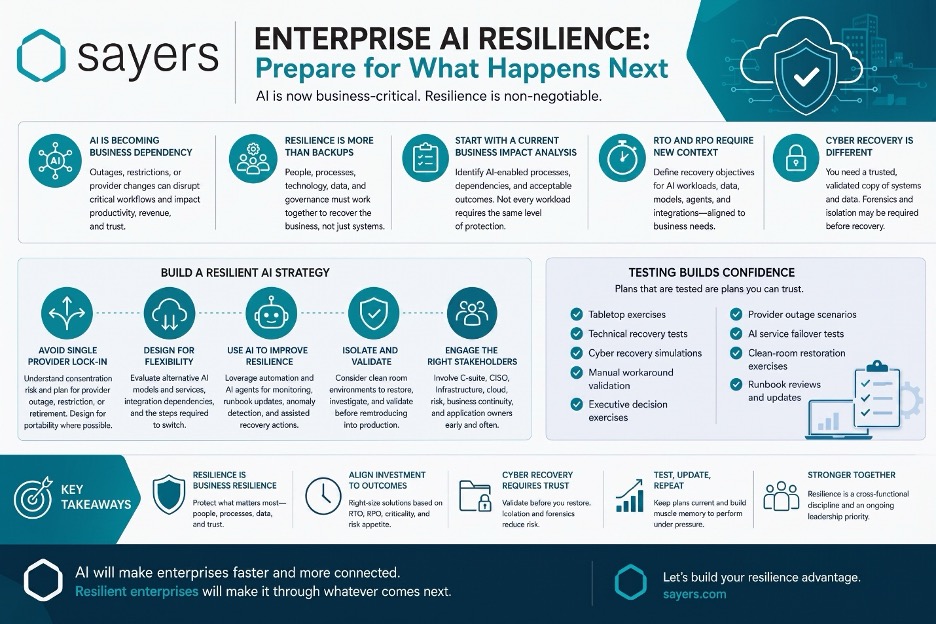
True resilience incorporates people, processes, technology, data, governance, and third-party dependencies.
An organization may possess many of the necessary technical components and still lack a cohesive recovery capability. Backup systems may exist, but recovery priorities may be unclear. Runbooks may have been created but not updated. Business continuity plans may not reflect current cloud and AI dependencies. Technical teams may be able to restore systems without knowing which business services should be recovered first.
This is why resilience cannot be treated as a storage project or an annual compliance exercise. It is an operating capability that connects business requirements to technical recovery decisions.
For AI workloads, that connection is especially important. An AI solution may depend on an external model, cloud infrastructure, identity services, application programming interfaces, vector databases, proprietary data, security controls, and multiple software integrations. Restoring only one component will not necessarily restore the business service.
Executives should require resilience planning at the complete workflow level.
A business impact analysis, or BIA, provides a logical starting point. The BIA identifies critical business processes, evaluates the effects of disruption, and helps establish recovery priorities.
Many organizations conduct BIAs periodically, but the results can become outdated as the technology environment changes. AI adoption makes this problem more urgent because new dependencies may be introduced rapidly by business units, technical teams, and individual employees.
Leaders should ask:
These questions help distinguish a useful AI feature from a genuinely business-critical capability. They also create a foundation for investment decisions.
Not every workload requires the same level of protection. The correct solution should reflect the business requirement rather than the popularity of the technology.
Recovery time objective, or RTO, defines how quickly a service must be restored. Recovery point objective, or RPO, defines how much data loss the organization can tolerate.
These measures remain fundamental, but AI introduces additional considerations.
For example, an enterprise may need to identify acceptable recovery points for training data, prompts, agent configurations, orchestration logic, knowledge repositories, model outputs, audit records, and application integrations. Leaders must also determine whether restoring historical data is enough, or whether the organization must validate the integrity and trustworthiness of that data before reconnecting an AI system.
A practical analogy is emergency power. One facility may require a sophisticated whole-building generator, while another may only need a smaller unit capable of supporting a limited number of essential systems. Neither solution is automatically right or wrong. The appropriate investment depends on the requirement.
The same principle applies to AI resilience. A low-impact productivity assistant may tolerate a lengthy outage and rely on a manual workaround. An AI-enabled security or customer-facing process may require rapid restoration, alternate providers, stronger isolation, and more frequent testing.
The role of leadership is to make those requirements explicit.
Traditional disaster recovery commonly assumes that the organization is restoring systems after an operational failure, natural disaster, or infrastructure outage. Cyber recovery introduces a more difficult challenge: determining whether the systems and data being restored can be trusted.
Following a cyberattack, the newest backup is not necessarily the safest recovery point. Systems may require forensic examination before they are returned to production. Data may have been altered. Credentials may be compromised. Malicious code may remain dormant. AI knowledge sources or agent instructions may have been contaminated.
As a result, cyber recovery requires a trusted and validated copy of critical systems and data.
Organizations should evaluate whether they need an isolated recovery environment, sometimes described as a clean room. Such an environment can provide a controlled location for restoration, investigation, validation, and testing before workloads are reintroduced into production.
For AI-enabled processes, this could mean validating not only the underlying servers and databases, but also the data sources, model connections, agent permissions, automation logic, and downstream actions.
This added complexity is why cyber resilience conversations frequently involve both technology and security leadership. The CISO may play a central role, but infrastructure, cloud, application, risk, compliance, continuity, and business teams must also participate.
Resilience planning should include the possibility that a specific model or service becomes unavailable. The cause could be a provider outage, contractual change, security concern, service retirement, regulatory restriction, or organizational decision.
Enterprises should not assume that switching providers will be immediate or simple. Different models may produce different results. Integrations may rely on provider-specific interfaces. Security controls, data-handling practices, performance characteristics, and governance requirements may differ.
A credible portability strategy should answer several questions:
This does not require every organization to operate multiple AI platforms at all times. It does require leaders to understand concentration risk and make a conscious decision about how much dependency is acceptable.
Use AI to Strengthen Resilience
AI is not only a workload that must be protected. It can also become an important tool for improving resilience.
AI-enabled automation may help organizations move from reactive recovery toward self-healing and self-optimizing operations. Potential uses include identifying abnormal behavior, correlating operational signals, recommending recovery actions, updating runbooks, checking configuration consistency, and assisting technical teams during an incident.
AI agents may eventually support portions of the recovery process by collecting evidence, validating prerequisites, documenting actions, and coordinating repeatable workflows. These capabilities should be governed carefully and tested before they are trusted in a crisis.
Human accountability remains essential. Automated recovery actions can create additional risk if they are based on incomplete information or have excessive permissions. The objective should be controlled augmentation, not unmonitored autonomy.
Testing Builds Organizational Muscle Memory
A recovery plan that has never been tested is an assumption.
Testing helps people understand their responsibilities, exposes outdated dependencies, validates technical procedures, and reveals whether documented recovery objectives are realistic. It also builds muscle memory so teams can respond more quickly under pressure.
A mature testing program can include:
Testing should reflect realistic business conditions. An AI outage during a quiet period may have limited consequences. The same outage during a financial close, customer event, security incident, or major operational deadline could have a significantly greater impact.
The Executive Agenda for AI Resilience
AI resilience is not a future problem. The dependencies are being created now.
C-level and director-level IT leaders should begin by identifying production AI use cases, mapping their business dependencies, and incorporating them into BIA, disaster recovery, cyber recovery, and continuity planning. From there, the organization can define appropriate RTO and RPO requirements, evaluate concentration risk, establish manual workarounds, and determine whether isolated recovery capabilities are needed.
The most productive leadership conversation may begin with three questions:
1. How confident are we that we can recover from a cyberattack?
2. When did we last validate our business impact analysis?
3. How would critical operations continue if our primary AI services became unavailable?
The answers will reveal whether the organization has a collection of recovery technologies or a genuine resilience capability.
AI will make enterprises faster, more automated, and increasingly dependent on interconnected platforms. The organizations that benefit most will not be those that simply adopt AI first. They will be those that build AI into a tested, adaptable, and business-aligned resilience strategy.