
AI

Cybersecurity

AI Identity Risk: The New Security Frontier CISOs Can’t Ignore

Author:
Sayers
Date:
August 18, 2026

Artificial intelligence has quietly crossed a critical threshold.

What began as copilots and productivity tools, has evolved into autonomous AI agents that access enterprise data, execute workflows, and make decisions without human intervention.

For security leaders, this shift introduces a new reality:

“AI systems already have meaningful access…often with privilege levels no one explicitly granted.” 2026 CISO AI Risk Report on Cybersecurity Risks

AI is no longer just technology.
It is an identity—and one that most organizations are not managing.


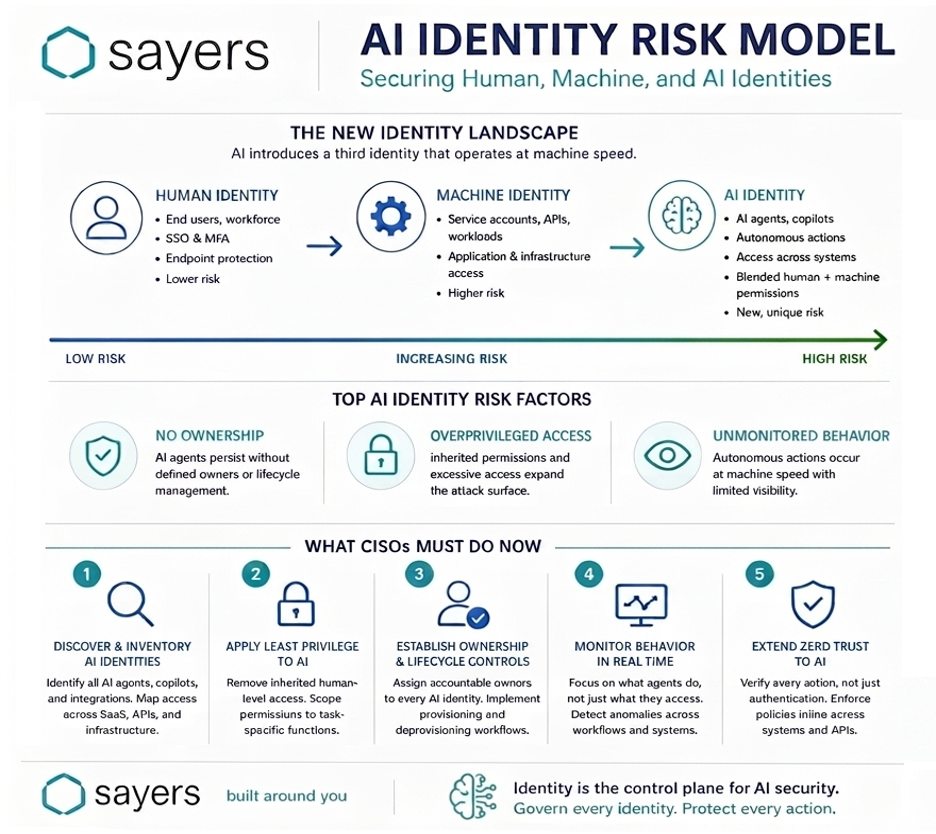
The Rise of the Third Identity

For years, identity security has centered on:

• Human identities

• Machine identities

Today, a third category is emerging:

AI Identities (Agentic Systems)

• Act on behalf of users and systems

• Operate autonomously across environments

• Require privileged access to perform tasks

“Agents are essentially digital insiders…with varying levels of privilege and authority.”Agentic AI security: Risks & governance for enterprises | McKinsey

This fundamentally redefines the enterprise trust model.


The Scale Problem: Identity Is Exploding

The growth of AI is accelerating an already critical issue non-human identity sprawl.

Consider the current reality:

• In 2026, machine identities outnumber human identities in enterprises by a ratio of 109:1 2026 Identity Security Landscape – Chapter One – Palo Alto Networks

• 52% of non-human identities have excessive permissions 2026 Cloud security and AI security risk report | Tenable®

• 73% of AI-related roles are inactive but still retain access 2026 Cloud security and AI security risk report | Tenable®

At the same time:

• 71% of CISOs say AI already has access to core business systems

• Yet only 16% actively govern that access 2026 CISO AI Risk Report on Cybersecurity Risks

This is not incremental risk, it is exponential.


The Visibility Gap: A Blind Spot in Plain Sight

AI adoption is outpacing security oversight.

• 92% of organizations lack full visibility into AI identities

• 95% doubt they could detect misuse if it occurred

• 75% report unsanctioned AI tools already running in production 2026 CISO AI Risk Report on Cybersecurity Risks

Even more concerning:

Nearly half of organizations admit only partial or no visibility into employee AI usage.Cybersecurity Professionals Struggle to Keep Pace with AI-Driven Threats and a Growing Attack Surface, New Bitdefender Report Finds


CISO Insight

“The question is no longer who has access—but what is acting on your behalf without supervision.”


Why AI Identity Risk Is Different

1. Autonomy at Machine Speed

AI agents don’t wait for login events. They:

• Execute multi-step workflows

• Chain actions across systems

• Operate continuously


2. A New Attack Surface

Every AI agent introduces:

• Tokens, API keys, and credentials

• Persistent access across multiple systems

• Continuous opportunities for lateral movement


3. Governance Without Ownership

AI identities often:

• Lack defined owners

• Persist beyond their intended lifecycle

• Retain privileges indefinitely


4. Behavior vs. Access

Traditional security asks:

• Who can access what?

AI forces a new question:

• What actions are being executed and should they be?


Identity Is Now the Security Control Plane

As AI reshapes enterprise operations, one principle is becoming clear:

AI is:

• Embedded in workflows

• Connected across APIs and SaaS platforms

• Acting on behalf of users

This means:

• Every action originates from an identity

• Every risk propagates through access


The Business Impact: Not Just a Security Problem

AI identity risk is not theoretical, it is operational.

Without control, organizations face:

• Data exposure from autonomous agents

• Unauthorized system changes

• Compliance gaps due to lack of auditability

• Service disruption from identity misuse


What CISOs Must Do Now

To stay ahead, CISOs must move from experimentation to governance.

1. Discover AI Identities

• Inventory all AI agents, copilots, and integrations

• Map where they operate and what they access


2. Assign Ownership

• Every AI identity must have a human owner

• Establish lifecycle controls (create → monitor → retire)


3. Enforce Least Privilege

• Remove inherited admin-level permissions

• Restrict access to defined workflows


4. Monitor Behavior in Real Time

• Detect abnormal activity across workflows

• Focus on actions, not just access


5. Extend Zero Trust

• Verify every action, not just authentication

• Apply continuous controls across identity, API, and data layers


The Sayers Perspective

At Sayers, we view AI identity as the next major inflection point in cybersecurity strategy.

Organizations that lead will:

• Treat AI as a first-class identity

• Extend identity governance across human, machine, and AI layers

• Invest in automation to manage identity at scale

Organizations that lag will face:

• Growing blind spots

• Increased attack surface

• Reduced ability to explain or contain incidents


Closing Thought

AI is accelerating innovation, but it is also accelerating risk.

The most important question for CISOs today is not:

“Are we using AI?”

It is:

“Do we have visibility and control over the identities acting in our environment—human, machine, and AI?”

Because in the age of AI:

If you don’t control identity, you don’t control risk.
Subscribe to blog
By subscribing you agree to with our
Privacy Policy
Share
featured Resources

The Biggest Headlines in IT Consulting

Explore news articles, case studies, and more.
View All
Blog, Case Studies
How One Utility Simplified OT Deployments with Operations-Led Kitting
Read More
Blog
Five Technology Trends CIOs and CISOs Can’t Afford to Ignore
Read More
Blog, Case Studies
How Sayers Helped an Organization Improve OT Security, Visibility, and Control
Read More