Blog, Case Studies
Building a Trusted Security Operations Partnership for Enterprise Firewall Management
Read More



Artificial intelligence has quietly crossed a critical threshold.
What began as copilots and productivity tools, has evolved into autonomous AI agents that access enterprise data, execute workflows, and make decisions without human intervention.
For security leaders, this shift introduces a new reality:
“AI systems already have meaningful access…often with privilege levels no one explicitly granted.” 2026 CISO AI Risk Report on Cybersecurity Risks
AI is no longer just technology.
It is an identity—and one that most organizations are not managing.
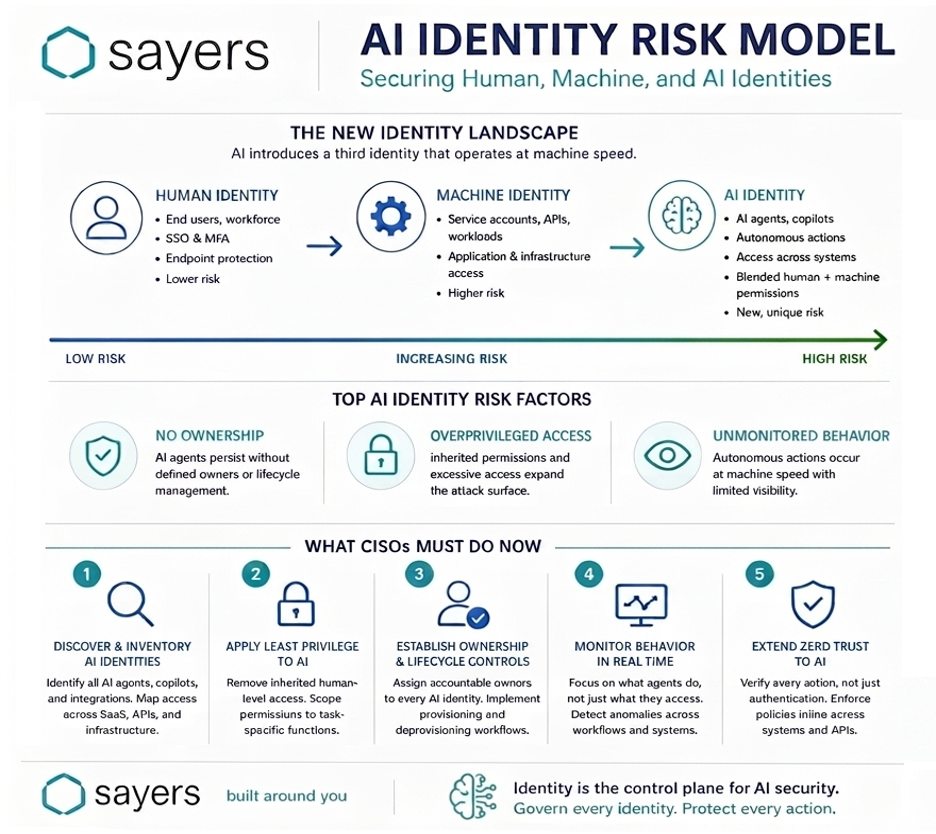
For years, identity security has centered on:
Today, a third category is emerging:
AI Identities (Agentic Systems)
“Agents are essentially digital insiders…with varying levels of privilege and authority.”Agentic AI security: Risks & governance for enterprises | McKinsey
This fundamentally redefines the enterprise trust model.
The growth of AI is accelerating an already critical issue non-human identity sprawl.
Consider the current reality:
At the same time:
This is not incremental risk, it is exponential.
AI adoption is outpacing security oversight.
Even more concerning:
Nearly half of organizations admit only partial or no visibility into employee AI usage.Cybersecurity Professionals Struggle to Keep Pace with AI-Driven Threats and a Growing Attack Surface, New Bitdefender Report Finds
“The question is no longer who has access—but what is acting on your behalf without supervision.”
Why AI Identity Risk Is Different
1. Autonomy at Machine Speed
AI agents don’t wait for login events. They:
2. A New Attack Surface
Every AI agent introduces:
3. Governance Without Ownership
AI identities often:
4. Behavior vs. Access
Traditional security asks:
• Who can access what?
AI forces a new question:
• What actions are being executed and should they be?
As AI reshapes enterprise operations, one principle is becoming clear:
AI is:
This means:
The Business Impact: Not Just a Security Problem
AI identity risk is not theoretical, it is operational.
Without control, organizations face:
To stay ahead, CISOs must move from experimentation to governance.
1. Discover AI Identities
2. Assign Ownership
3. Enforce Least Privilege
4. Monitor Behavior in Real Time
5. Extend Zero Trust
At Sayers, we view AI identity as the next major inflection point in cybersecurity strategy.
Organizations that lead will:
Organizations that lag will face:
AI is accelerating innovation, but it is also accelerating risk.
The most important question for CISOs today is not:
“Are we using AI?”
It is:
“Do we have visibility and control over the identities acting in our environment—human, machine, and AI?”
Because in the age of AI:
If you don’t control identity, you don’t control risk.