Blog
AI Foundations: Who Owns AI?
Read More



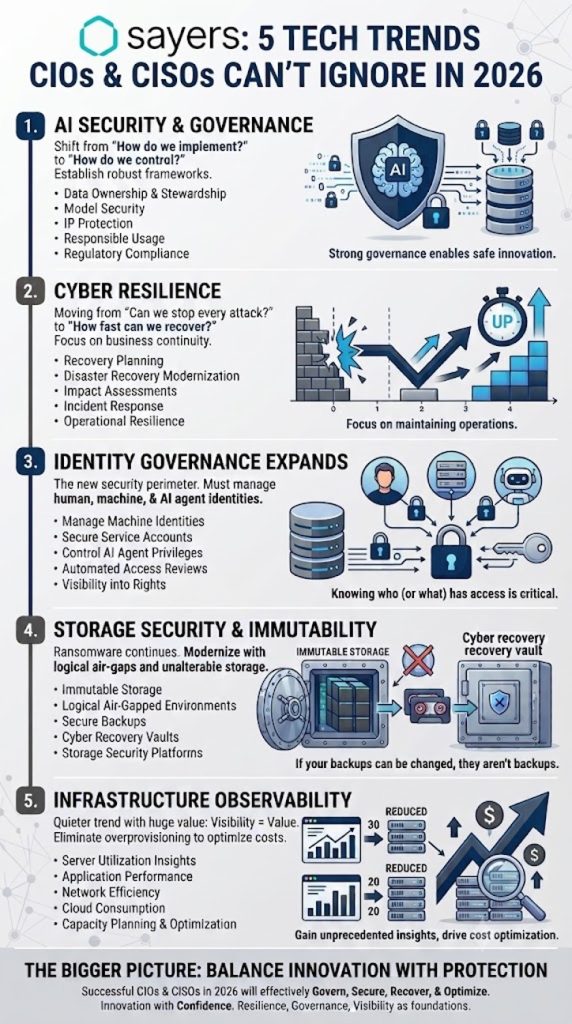
The pace of technological change has never been faster, and the convergence of artificial intelligence, cybersecurity, data management, and infrastructure optimization is forcing leaders to rethink traditional IT strategies. During a recent discussion among technology and security engineering leaders, a clear theme emerged: organizations are entering a new era where resilience, governance, and operational intelligence are becoming just as important as innovation itself.
For CIOs and CISOs, the challenge is no longer determining whether these trends matter, it is deciding how quickly they can adapt before competitors and threat actors force their hand.
Here are five technology trends that organizations should prioritize as they build their technology roadmaps for the coming years.
Artificial intelligence continues to dominate boardroom discussions, technology conferences, and strategic planning sessions. Most organizations are already experimenting with generative AI, AI-powered analytics, and autonomous agents that can automate business processes. However, as AI adoption accelerates, security and governance concerns are becoming impossible to ignore.
The conversation has shifted from “How do we implement AI?” to “How do we control it?”
Organizations are increasingly recognizing that AI systems introduce new risks related to data exposure, intellectual property protection, compliance, and decision-making transparency. Every AI initiative relies on data, making governance foundational to success. Poor data quality, inconsistent controls, and unmanaged access rights can quickly undermine even the most sophisticated AI deployment.
Technology leaders must establish governance frameworks that address:
The organizations that successfully leverage AI will not necessarily be the ones with the most advanced models. They will be the ones with the strongest governance practices that allow innovation to scale safely and sustainably.
As many industry experts have noted, data is the oxygen that fuels AI. Without strong governance, AI initiatives risk becoming liabilities instead of competitive advantages.
For years, cybersecurity strategy focused heavily on prevention. Organizations invested in firewalls, endpoint security, threat detection, and preventive controls designed to stop attacks before they occurred.
Today, that mindset is evolving.
Security leaders increasingly recognize that preventing every attack is unrealistic, particularly as threat actors begin leveraging generative and agentic AI technologies to accelerate reconnaissance, phishing, malware development, and exploitation efforts.
The more important question is no longer:
“Can we stop every attack?”
Instead, organizations are asking:
“How quickly can we recover when an attack succeeds?”
This shift has elevated cyber resilience to one of the most important technology priorities in 2026.
Cyber resilience focuses on maintaining business operations during and after a cyber event. Leading organizations are investing in:
Executives are increasingly demanding quantifiable answers to critical questions:
Organizations that can answer these questions and demonstrate recovery readiness are significantly better positioned to withstand modern cyber threats.
Identity has become the new security perimeter.
As enterprises adopt cloud services, hybrid work environments, SaaS platforms, and AI-driven automation, managing identities has become exponentially more complex. Historically, identity governance focused primarily on employees and contractors. Today, organizations must also manage machine identities, service accounts, and AI agents.
The emergence of autonomous AI agents may represent one of the most significant identity management challenges organizations have faced.
These digital workers often need access to:
Without proper governance, AI agents can accumulate excessive privileges, creating significant security risks.
Fortunately, identity governance solutions are becoming more accessible. Modern platforms provide organizations with better visibility, automated access reviews, policy enforcement, and lifecycle management capabilities without requiring the extensive investments associated with legacy identity programs.
Leading organizations are now treating identity governance as a critical business enabler rather than simply a compliance requirement.
In the AI era, knowing who or what has access to your systems may become one of the most important security controls an enterprise can implement.
Ransomware continues to dominate cybersecurity headlines, and recent attacks demonstrate that mature organizations remain vulnerable.
Despite years of awareness campaigns and security investments, many businesses still lack adequate protections around backup infrastructure and recovery environments.
Technology leaders continue to emphasize the importance of:
Immutable storage has become particularly valuable because it prevents backup data from being altered or deleted, even if attackers gain administrative access.
This capability significantly strengthens an organization’s ability to recover from ransomware events.
What is surprising is that many organizations have yet to implement these foundational capabilities. Security teams frequently discover environments where backups remain vulnerable to attack, retention policies are inconsistent, or recovery processes have never been fully tested.
Future-focused CIOs are increasingly investing in cyber storage strategies that combine security, resilience, and operational recovery into a unified approach.
The lesson is simple: if your backups can be encrypted, deleted, or manipulated by attackers, they are not truly backups.
While AI and cybersecurity receive much attention, another trend is quietly delivering significant business value: infrastructure observability.
The rising cost of data centers, cloud services, virtualization platforms, and hardware has forced IT leaders to scrutinize resource utilization more closely than ever before.
Many organizations are discovering a surprising reality:
They are substantially overprovisioned.
Through modern observability tools, organizations are gaining unprecedented insight into:
These insights often reveal opportunities to eliminate unnecessary infrastructure while maintaining or even improving performance.
For example, organizations may discover that workloads running across thirty servers can operate effectively on twenty. The resulting reductions in software licensing, hardware maintenance, energy consumption, and cloud costs can generate substantial savings.
Infrastructure observability has evolved beyond monitoring and troubleshooting.
It is now a strategic business tool that enables:
In an environment where IT budgets are under constant scrutiny, visibility equals value.
Although these five trends differ in scope and focus, they share a common theme: organizations must balance technological innovation with operational discipline.
AI promises transformational business outcomes, but it requires governance.
Cyber threats continue to evolve, making resilience more important than prevention alone.
Identity management must expand beyond people to include machines and AI agents.
Storage infrastructure must be designed for recovery rather than convenience.
And infrastructure observability must become a business intelligence tool for optimizing technology investments.
For CIOs and CISOs, success will not be measured solely by how quickly they adopt emerging technologies. It will be measured by how effectively they govern, secure, recover, and optimize them.
The organizations that embrace these trends today will be better positioned to innovate with confidence tomorrow. In a world increasingly driven by AI and digital transformation, resilience, governance, and visibility have become the foundations of sustainable technology leadership.